Showing posts with label meta. Show all posts

Tuesday, February 23, 2010

Tips: get outa my head


Attention nonwriting public: we don't want to talk to you about our book.

Talking to non-writers about your project is like telling a stranger about the dirty dream you had last night, except not only did you have it, but you're so proud of it you want to charge people money to read about it. 

Why do non-writers care so much about a profession that has nothing to do with them?

1. They think writers are wizards. They want to see a trick.


2. Like all Americans, they believe they could be a writer, if they had enough time or took the right memoir writing class at the learning annex; talking to you is a servicable substitute.


3. They're bored and assume you can entertain them with your book idea, because all stories start out as brilliantly as the end-product they check out of the liberry on DVD.


4. They don't understand that creative people often don't talk about their process because to them, the creative process is exacly like baking a cake. From a box. Who doesn't love showing off their birthday cake? (Don't get me wrong, this is not about the cake. I am not dragging cake into this.)

So you tell them to be polite and you get that look: 'Oh. That doesn't sound anything like [insert favorite hack author].' 

So what do you say when a non-writer has put you on the hot spot?

1. Rattle off technical jargon like pacing, branding, genre, ouvre, feminist menstrual journey.

2. If you have an MFA, recite the plot of The Faerie Queene or Remembrance of Things Past, as you interpreted it from the Spark Notes.

3. Retell your latest office gossip as set in 1066 England, Mordor, or a space ship, as pertains to your genre.

4. After ten seconds of listening to you, they will be feeling jealous and wish to dominate the conversation again. So, claim the book is about crochet or scrapbooking so they can naturally segue the conversation back to their own creative efforts.


5. Ask them about their kids.


Photo credit.

Sunday, February 21, 2010

Ways to Grab An Editor

Photobucket 
5 Ways Your MSS Can Grab an Editor
(And avoid the slush pile.)

Editors have literally piles of manuscripts lining their halls and no time to read them. They will only read the first three pages of your work, and if it grabs them, they'll try the next 20 pages. Maybe. 

Here's some tips to to keep them reading.

1) You should be spending weeks crafting your first sentence, first paragraph, and first chapter. Go back to it often as you write your book. It should be quick, show action, and have dialogue.

2) Don't info dump in your first page. Do not open your book with a description of the scenery, the character's life, or anyone's relationship. Jump straight into the action. Use dialogue, props, clothing, the 5 senses, and other details to suggest information. Readers want to figure things out at the beginning, not be told.


3) Cut your introduction, prologue, preface, preamble, or whatever you're calling it. These chapters are the thing you write when you are new to the world. Later on, as you worldbuild, everything you've put in the preface comes out in the main story, making the preface an unnecesary info dump. So get rid of it. I'm looking at you, fantasy writers: You don't need it.

4) Edit judiciously. Do you really need three best friends, three villains, or three towns? Consider combining similar elements into one. Make the prose move faster by cutting out unnecesary words, sentences, paragraphs, scenes, chapters. How many times do you reiterate your theme, conflict, or point? Say less and it makes the telling more powerful. 

5) Read your first chapter aloud. Mark where you trip over the words or have to reread to make a sentence clear. If you can read it aloud clearly without a hitch, then a stranger will read the prose as smooth and elegant.
 
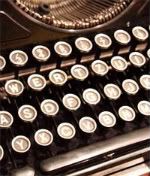
Photo credit: Old typewriter by Petr Kratochvil  

Tuesday, February 9, 2010

Tips: Novel writing

Photobucket

In my writing program, we had writing partners each semester, whose work we shared and critiqued each month. It was always a learning experience to find out what we all had been doing all along was very annoying to the reader, or simply didn't make sense.

Here's some unconscious common habits a lot of writers have that put a wall up between their work and their readers -- or worse, a potential editor.

1) Type dot dot dot when your character's thoughts or speech go off into space. Type dashdash when he is interrupted. Type four dots when you want a long pause that follows a complete sentence. Read other common errors in English you don't know you're making.

2) You know how college taught you the high art of the semicolon? Forget all that. Semicolons in fiction are very expensive, don't use too many on a page. Also, remember that. Short sentencs. Equal. Action!

3) You might not be an outliner, but I don't know any novel writer who doesn't have to do some written down prewriting. Read books and websites about structure and plotting until you find the outlining/worldbuiling method that works for you, because nothing is worse than your plot going nowhere, or your villain's name or species changing every 50 pages. Some people use writer's software, some do an encyclopedia of their world in Word, some use Q&A format in Excel, some hang up poster boards using actors and magazine landscapes. You need something other than your mss to keep you on task.

4) Join a professional guild and consider attending conferences. It doesn't have to be exactly what you're into -- ie, your average romance writer's group will welcome fantasy and women's fiction writers. It's invaluable to know what's new in you genre and, perhaps more importantly, what's so old it's unsellable.

5) "Said" is fine as a dialogue tag.  "Blah blah," Beatrice said is fine to put down 50 times in a conversation. "Said" is one of those words that readers skip over, almost like a punctuation mark. Similarly, do not use 10 synonyms for "said" because repeating "said" feels repetitive to you. Of course it's repetitive - that's why readers skip over it and pay attention to the dialogue. Do you want your prose to be awkward and obvious?

6) More on dialogue: Character voice is the most important element of your book to lending personality to your characters, but unfortunately our TV culture has corrupted how we "see" conversation in the written format. Find other ways to convey your character's mood than using adjectives to describe their voice, because that way leads to talking heads; you are not writing a script, there will be no actors putting life into your scene, pages of dialogue and "-ly" lead to boring talking heads.

7) Consider every single bit of concrit you ever get. Humble yourself. Find other author friends and solicit their opinions.Take classes at adult education centers or libraries. Read books on writing and do the exercises. Write something every day.

7) Keep your first rejection letter. Frame it. Throw it a little party. It means you're a real writer. 

Photo credit: Old typewriter by Petr Kratochvil  

Sunday, January 17, 2010

tips: writer's block


When I was in grad school, we had to write a novel in 2 years and about 30 pages a month. There was no time for writer's block. So these are ideas we passed around to keep from flunking out.

- Retype your last page

- Create a playlist or Pandora channel of music that's suited to your story, genre, or character. Create several for different points in your story or book.

- Write anything for ten minutes. Don't edit. Just type. Look back over what you're written and find something to go with.

- Warm up each writing session with a fifteen minute freewriting session - something not related to your project. Prompts are good for this. It takes the pressure off and gets you in the writing mindframe.

- Have a work area and work there every day.

- Leave your work area and go somewhere else: outside, a coffee shop, the library, a diner. Bring headphones. 


- Use story mapping software like Freemind to see your ideas in one place.


- Think about why you're having a hard time writing something. Do you really want to write this? Does it not fit the story? If writing a certain character or scene is a chore, it may be a chore for your readers, too. (Did we really need all that Quidditch, JK?)


BTW: Did someone tell you that writing was about artistry and being inspired all the time? It's not. Ideas are easy, anyone can have ideas. Writing is the work of making something out of those ideas. If you're not working like it's 4 am and your paper is due at 9, you're not writing.

Tuesday, January 12, 2010

Writing prompt responses is useful because -

- Writing something every day keeps your momentum; if you're stuck on your main project, a short prompt response is better than nothing.

- A prompt can encourage you to explore a new voice, genre, character, or style.

- Prompts can help you build confidence as a writer.

- Prompts encourage experimentation, which can help you find what you really want to do with your writing.

Wednesday, January 6, 2010

I liked the 'in another place' prompt because I could place someone where I thought they really belonged. Elyse is my cousin, who's a latter day hippie, a counselor struggling to find a paying position, and a Dead head. I just feel like she'd be happier in another decade, when a bachelor's degree in psychology actually meant something, and crusty 20 year olds could follow the Dead in ripped jeans for a year. When it was still safe to hitchhike to a campground with your boyfriend in some dude's VW bus. I think she'd have freedom to have a lot more experiences if she wasn't tied to some crap job and $50,000 in student loans, and then she'd use those experiences to do something really wonderful, like start a women's shelter. 

Anyway. What is freewriting? It's just what it sounds like - put fingers to keys and make words come out. I'm doing this blog for a lot of reasons, but what I get out of it is a reason to write something new every week. I'm working on a novel and I have a job, but that's just *work*. It gets stifling, boring. I'm hoping you people will give me more to want to write for.